Lights, Camera, Bitch Smile Retro Review
As a designer who spends half my life troubleshooting thread breaks and the other half trying to make handmade goods look professional enough for boutique shelves, I don’t just buy digital assets; I stress-test them. When I first pulled up Lights, Camera, Bitch Smile Retro, I wasn’t looking at it as just another SVG file. I was looking at it as a potential finished product waiting to happen. The title alone sets a tone that is bold, unapologetic, and deeply rooted in vintage cinema culture. It’s not subtle, and honestly, for the right market, subtlety is the last thing you want.
This review isn’t about whether the file opens correctly in your software—that’s a technical baseline. This is about how this design behaves under the needle, how it translates from a flat vector to a textured textile, and whether it has the commercial viability to move units on Etsy or add value to a craft fair booth. We are diving into the practical realities of turning this Graphics category asset into a tangible Crafts success story.
First Impressions: The Mood and Visual Personality
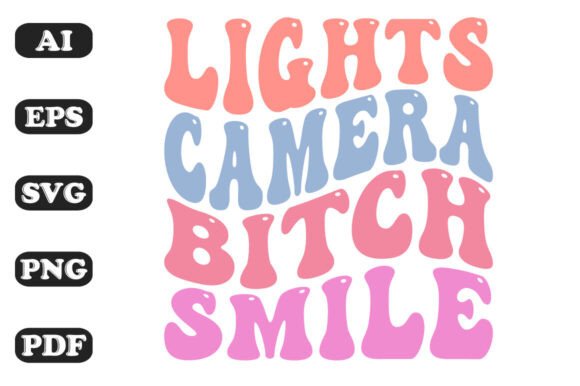
The immediate vibe of Lights, Camera, Bitch Smile Retro is nostalgic with an edge. It taps into that mid-century Hollywood glamour but twists it with modern, irreverent humor. For an embroidery designer, the challenge with text-heavy retro designs is always legibility after stitching. If the curves are too tight or the font weight is inconsistent, what looks sharp on screen turns into a muddy blob on fabric.
Visually, this design feels like it belongs on structured garments. The layout suggests a central focal point, likely featuring a stylized face or typographic element that commands attention. It screams "statement piece." It doesn’t whisper; it announces. This makes it perfect for customers who want their apparel to reflect a specific attitude—fun, fierce, and slightly chaotic. It’s the kind of design that catches the eye across a crowded room at a maker market because it’s distinct. It avoids the generic floral or motivational quote tropes that saturate the market, offering instead something with actual personality.
Real-World Application: Where Does This Shine?
I’ve been thinking through various project scenarios for this design, and a few stand out as natural fits. Let’s talk about a custom embroidered tote bag. There is something inherently funny and chic about seeing a retro, sassy phrase stitched onto canvas. The contrast between the utilitarian nature of a tote and the polished look of machine embroidery creates a high-end feel. Imagine this on a heavy-duty cotton canvas tote, perhaps using a high-contrast thread color like gold or bright red against a black bag. It becomes a handmade product that feels curated, not mass-produced.
Then there is the sweatshirt angle. A cropped hoodie or a boxy crewneck is the current uniform for many creative entrepreneurs and Etsy sellers. Stitching Lights, Camera, Bitch Smile Retro here allows for a larger format, giving the design room to breathe. The texture of the fleece or French terry adds depth to the stitches, making the satin stitch areas pop even more. It’s wearable art that works for casual Fridays or weekend errands.
I also see potential in baby items, though with a caveat. While the phrase might be too spicy for some parents, the "retro" aesthetic can be softened if executed carefully. Think of it as a gift for the cool aunt or uncle, or perhaps a humorous nursery accent if the typography is playful enough. However, for a direct-to-garment approach, adult apparel remains the safest and most profitable bet. An embroidered patch version could also work well for denim jackets or beanies, adding a touch of rebellion to classic staples.
Technical Considerations and Potential Pitfalls
No design is without its challenges, and Lights, Camera, Bitch Smile Retro is no exception. As an experienced reviewer, I have to flag where this design might struggle. First, consider the hoop size. If the original vector is large, scaling it down for small hoops (like 4x4 inches) can compromise detail. Tiny serifs or intricate lines in the retro graphics may disappear or merge together when stitched at a smaller scale. Always test the scaled-down version before committing to production.
Fabric choice is critical. This design likely relies on clean lines and solid fills. On stretchy knits, unless you use a proper tear-away or cut-away stabilizer, the tension can pucker the fabric, distorting the shape. On textured fabrics like bouclé or heavy tweed, the needle might struggle to penetrate evenly, leading to skipped stitches. Dark fabrics present another variable; if the design uses light threads, ensure the background fabric isn’t so dark that it shows through thin areas of fill stitch. Conversely, if you’re using white thread on white fabric, you’ll lose the definition entirely.
Also, think about the end-user experience. If this is going on a garment that will be washed frequently, such as a t-shirt or apron, the stability of the embroidery matters. Dense stitch areas can become stiff and uncomfortable if not digitized with appropriate underlay stitches. Check the stitch density in your software. If it’s too dense, the fabric will feel like cardboard. If it’s too sparse, the backing material might show through.
Practical Designer Notes for Execution
- Test on Scrap Fabric: Never go straight to the final garment. Run a test stitch on the exact same fabric type to check tension and thread behavior.
- Check Thread Contrast: View your design in black and white mockups to ensure the elements separate clearly. High contrast usually yields the best results for retro styles.
- Stabilizer Selection: Use a stabilizer that matches the fabric’s drape. Heavy fabrics need heavy stabilizers; lightweight knits need supportive but removable options.
- Inspect Small Details: Zoom in on the smallest letters or graphic accents. Are they wide enough to be stitched cleanly? If not, consider simplifying the design or increasing the minimum size.
- Licensing Verification: Before selling any finished items, double-check the license terms. Some digital embroidery files allow personal use only, while others permit commercial sales. Ensure you are compliant to protect your craft business.
Impact on Brand and Customer Trust
Using a strong, well-executed design like Lights, Camera, Bitch Smile Retro elevates your brand perception. Customers can tell the difference between a hastily printed transfer and a thoughtfully embroidered piece. The tactile quality of embroidery signals effort and quality. When a buyer sees this design professionally stitched, they associate that craftsmanship with your entire shop. It builds trust. It says, "I care about the details."
Furthermore, the uniqueness of the design helps with recognition. In a sea of generic listings, a design with a distinct voice stands out. It encourages social sharing. People love to post photos of their unique, funny, or stylish handmade items. This design has "shareability" built-in. It’s conversation-starting. That organic marketing potential is invaluable for any small shop product line.
Final Verdict
Lights, Camera, Bitch Smile Retro is a versatile, character-rich design asset that offers significant potential for both personal projects and commercial ventures. It thrives on structured garments, sturdy bags, and accessories where its bold message can be fully appreciated. By paying attention to technical details like hoop size, fabric compatibility, and stitch density, you can transform this digital graphic into a stunning physical reality.
For designers and sellers looking to add a bit of flair and fun to their inventory, this is a smart addition. It’s not just another clipart; it’s a statement. Just remember to test thoroughly, respect the licensing, and let the quality of your execution speak for itself. When done right, this design won’t just sit on a shelf—it’ll get worn, carried, and loved.